Four weeks into a U.S.-Israel war on Iran that has yet to find a ceiling, Pakistan has emerged as the unlikely fulcrum of diplomatic effort. Prime Minister of Pakistan, Shehbaz Sharif, announced Tuesday that Islamabad would host direct talks between Washington and Tehran. When President Trump reposted the announcement on Truth Social, the signal was unambiguous to anyone with reason to follow it closely.
The groundwork had been laid methodically in the preceding months. Pakistan’s Field Marshal Asim Munir held a substantive conversation with President Trump on Sunday. Sharif met with Iranian President Masoud Pezeshkian the following day, while Foreign Minister Ishaq Dar engaged his Iranian counterpart Abbas Araghchi on what the foreign ministry described, in the carefully calibrated register of professional diplomacy, as “recent regional developments.”
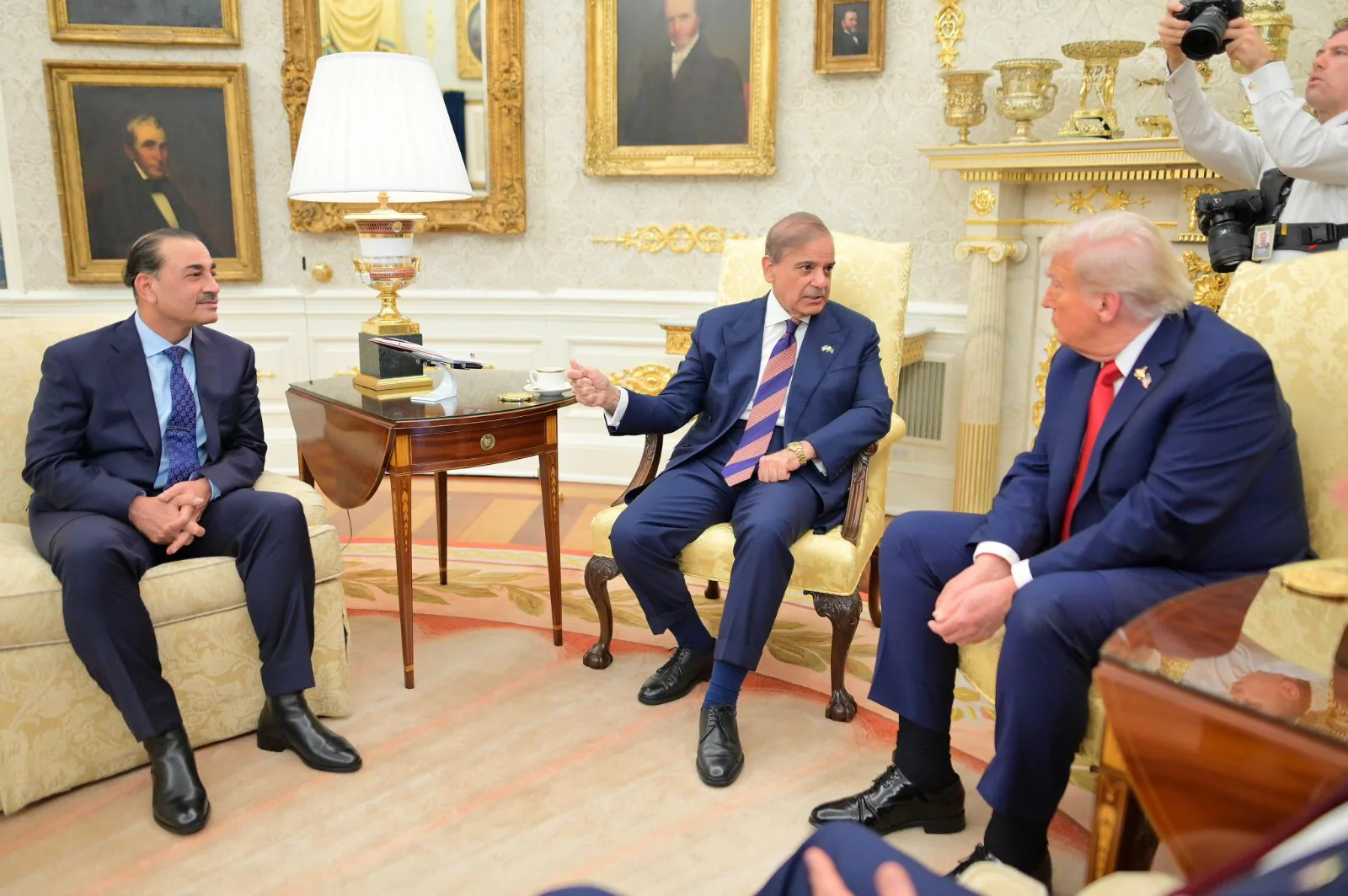
(Credit: Handout / PMO)
A peace summit to mediate in the U.S.-Israel War on Iran is now reportedly scheduled for Islamabad this week. Two formats are under consideration: one bringing Araghchi to the table with White House envoy Steve Witkoff and Jared Kushner, another convening Vice President JD Vance opposite Iranian Parliament Speaker Mohammad Bagher Ghalibaf. The White House declined to confirm any particulars. Press secretary Karoline Leavitt stated only that “sensitive diplomatic discussions” would not be conducted through the press.
Pakistan Has Always Been the Quiet Diplomat
Pakistan has occupied this role before, though seldom so publicly. In 1972, Islamabad engineered the back channel that culminated in Nixon’s visit to Beijing, an episode that established the country’s reputation for discreet, high-stakes mediation and one that successive generations of its foreign policy establishment have never entirely stopped drawing upon. More consequential still, in the present context, is the arrangement under which Pakistan’s Washington embassy has continuously housed Iran’s de facto diplomatic mission since the 1979 Islamic Revolution severed formal relations between the two countries.
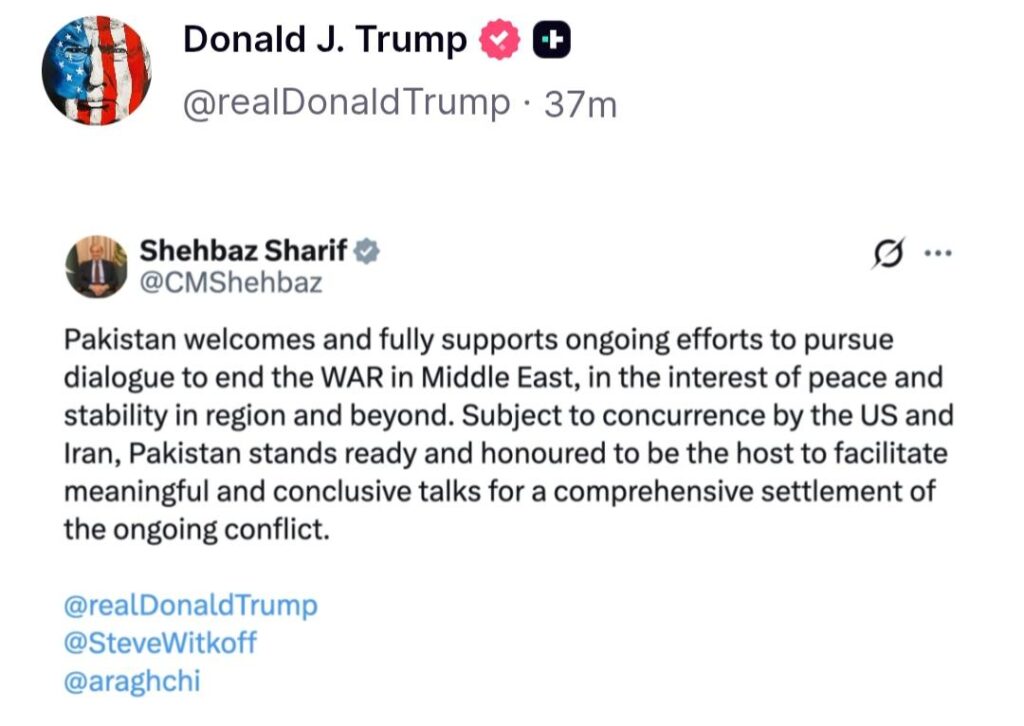
(Source: Official Truth Social and X accounts)
“Pakistan has unusual credibility as a mediator,” said Adam Weinstein, deputy director of the Middle East program at the Quincy Institute. “It maintains workable ties with both Washington and Tehran.” The fact that Pakistan is a non-Arab Muslim nation that hosts no American military bases further insulates it from the structural conflicts of interest that have systematically undermined mediation efforts by Gulf states.
Pakistan’s Dual Access
What distinguishes Pakistan at this particular juncture is its demonstrated capacity to sustain substantive, functioning relationships with both Washington and Tehran simultaneously. Field Marshal Munir cultivated the Washington relationship with evident and sustained deliberateness: in June 2025, he became the first Pakistani military chief, not head of state, but military chief, to be received for lunch at the White House. President Trump remarked publicly that Pakistan “knows Iran very well, better than most.” The political alignment has since been reinforced by deepening economic entanglement: Pakistan concluded an agreement with a Trump family-linked cryptocurrency firm to adopt its stablecoin for cross-border transactions, while Witkoff helped broker a redevelopment agreement for New York’s Roosevelt Hotel, a property held by Pakistan’s national airline.

(Source: ISPR, Pakistan)
The cultivation of Tehran has proceeded with comparable deliberateness and patience. Sharif and Munir traveled to Iran together last year, holding meetings with senior officials that included the late Supreme Leader Ayatollah Ali Khamenei. Since hostilities commenced on February 28, Sharif has spoken with Pezeshkian on multiple occasions. When Iran’s new supreme leader, Mojtaba Khamenei, referenced Pakistan by name in his Nowruz address, describing what he termed a “special feeling” toward its people.
Global Peace Summit – A Coordinated Push
Islamabad is not conducting this peace summit to mediate the U.S.-Israel war on Iran unilaterally. Turkey and Egypt have joined the initiative, together constituting what officials describe as a structured diplomatic relay between capitals that currently have no direct communication with one another. Foreign Minister Dar met with his Turkish counterpart, Hakan Fidan, on Monday, while Egypt’s Badr Abdelatty engaged his Iranian and Pakistani counterparts concurrently, alongside Witkoff and Qatar’s foreign minister. The institutional framework supporting this coordinated approach was assembled the previous week in Riyadh, where Saudi Arabia convened an emergency session of foreign ministers from a dozen Arab and Islamic nations, and the foreign ministers of Pakistan, Saudi Arabia, Egypt, and Turkey conducted a discrete alignment meeting on the sidelines.
The effort has already produced a measurable outcome. President Trump announced a five-day pause on strikes against Iranian power plants, characterizing recent exchanges as “very good and productive.” The pause expires Saturday.
Pakistan’s Diplomacy, Walking a Fine Line
Pakistan’s involvement is driven by imperatives of strategic self-preservation at least as much as by any disposition toward diplomatic engagement. The country shares a 900-kilometer land border with Iran, is home to the world’s second-largest Shia Muslim population, and absorbed the consequences of the conflict’s opening hours almost immediately: when U.S. and Israeli strikes killed Supreme Leader Khamenei on February 28, ten people died outside the American consulate in Karachi. The closure of the Strait of Hormuz, the maritime passage through which the preponderance of Pakistan’s hydrocarbon imports transit, has imposed sustained and quantifiable economic damage, compelling Islamabad to deploy naval escorts for its commercial shipping within days of the conflict’s outbreak.
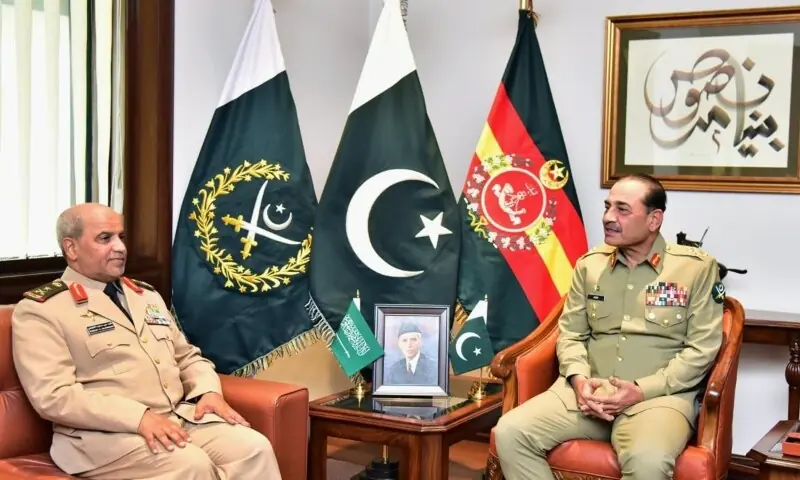
(Source: ISPR, Pakistan)
The mutual defense pact Pakistan concluded with Saudi Arabia in September introduces a dimension of legal and strategic exposure. Under its provisions, aggression against either signatory is formally treated as aggression against both. When Tehran struck Saudi Arabia, Foreign Minister Dar contacted Araghchi with the explicit purpose of placing that obligation on the record. The position Pakistan has constructed for itself is, in this respect, as precarious as it is consequential: it is endeavoring to negotiate the termination of a conflict that its own binding treaty commitments could yet require it to enter as a belligerent.
Economic Impact of U.S.-Israel War on Iran
The Strait as a Chokepoint
The closure of the Strait of Hormuz has produced the largest supply disruption in the recorded history of the global oil market. Roughly 20 million barrels of crude per day, one-fifth of all seaborne oil trade, normally transits the narrow waterway between Iran and Oman. That flow has collapsed to a trickle. Gulf producers, confronting exhausted storage capacity, have been compelled to curtail output. Iraq, which holds only six days of reserves, has cut production from 3.3 million barrels per day to 1.3 million.
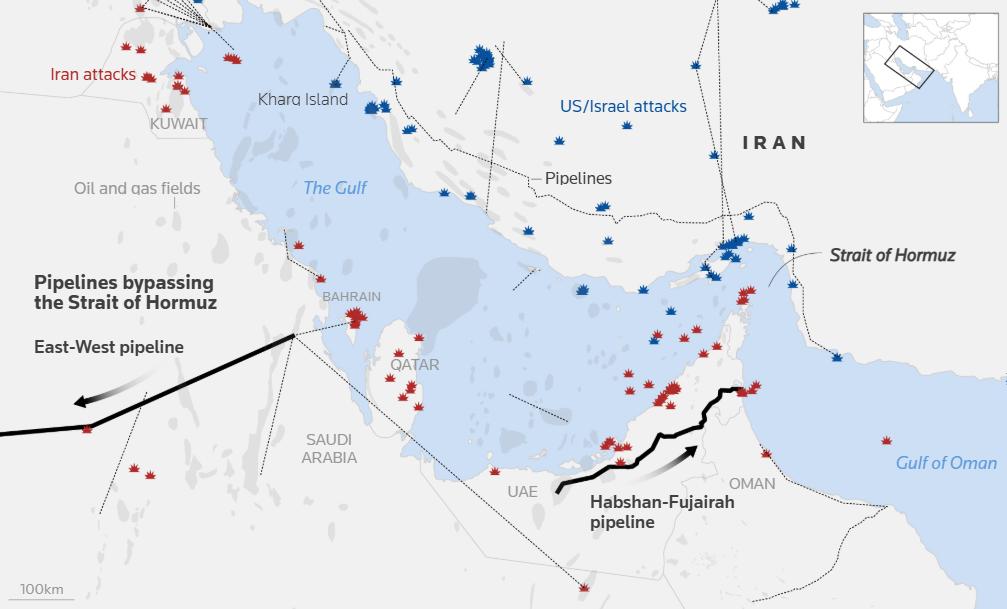
(Source: Global Energy Monitor, European Commission, and Institute for the Study of War & AEI Critical Threats Project.)
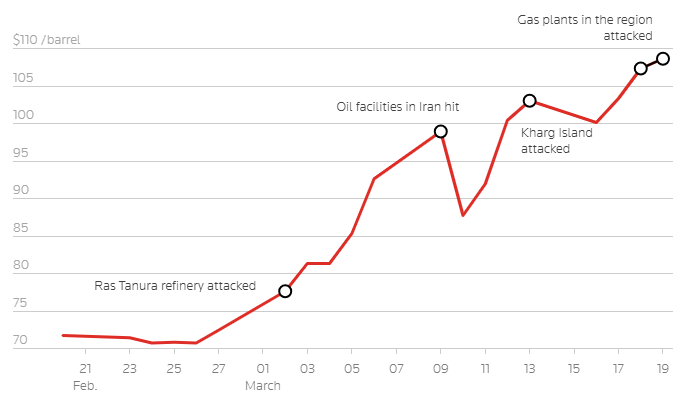
Brent crude has risen to nearly $120 per barrel, a 63 percent increase since the year began. Goldman Sachs has described it as the largest supply shock ever recorded in global crude markets. Unlike the 2022 disruption that followed Russia’s invasion of Ukraine, which permitted supply rerouting, this crisis represents a physical outage with no straightforward remedy. Alternative pipeline routes through Saudi Arabia and Iraq offer only 3.5 to 5.5 million barrels per day of spare capacity, a figure that falls well short of compensating for the shortfall.
Asia Bears the Burden Amidst the U.S.-Israel War on Iran
The economic pain is distributed unevenly, and Asia is absorbing the greatest share of it. More than 80 percent of the oil and liquefied natural gas that transited Hormuz in 2024 was destined for Asian markets, principally China, India, Japan, and South Korea. Japan sources 90 percent of its crude imports from the Middle East; South Korea, 70 percent. Both governments have activated market-stabilization measures. For less insulated economies, the pressure is more acute: Vietnam holds fewer than 20 days of oil reserves, as do Pakistan and Indonesia, while Bangladesh has capped fuel sales, closed universities early, and deployed troops to oil depots.
Fertilizer, Food, and Inflation
The disruption extends well beyond energy. Approximately 30 percent of global urea trade moves through the Strait, and prices have risen roughly 30 percent over the past month alone. Qatar’s fertilizer operations have halted following strikes on gas facilities. The timing is particularly damaging: the Food and Agriculture Organization has warned of a major shock to global food systems precisely as the Northern Hemisphere spring planting season begins.
The macroeconomic consequences are registering at the highest levels. The WTO has projected that sustained elevated energy prices could reduce global GDP growth by 0.3 percent, with Europe potentially absorbing a contraction of at least one percentage point. Goldman Sachs forecasts GDP contractions of 14 percent for Kuwait and Qatar should the conflict persist through April, with Saudi Arabia and the UAE facing reductions of 3 percent and 5 percent, respectively.
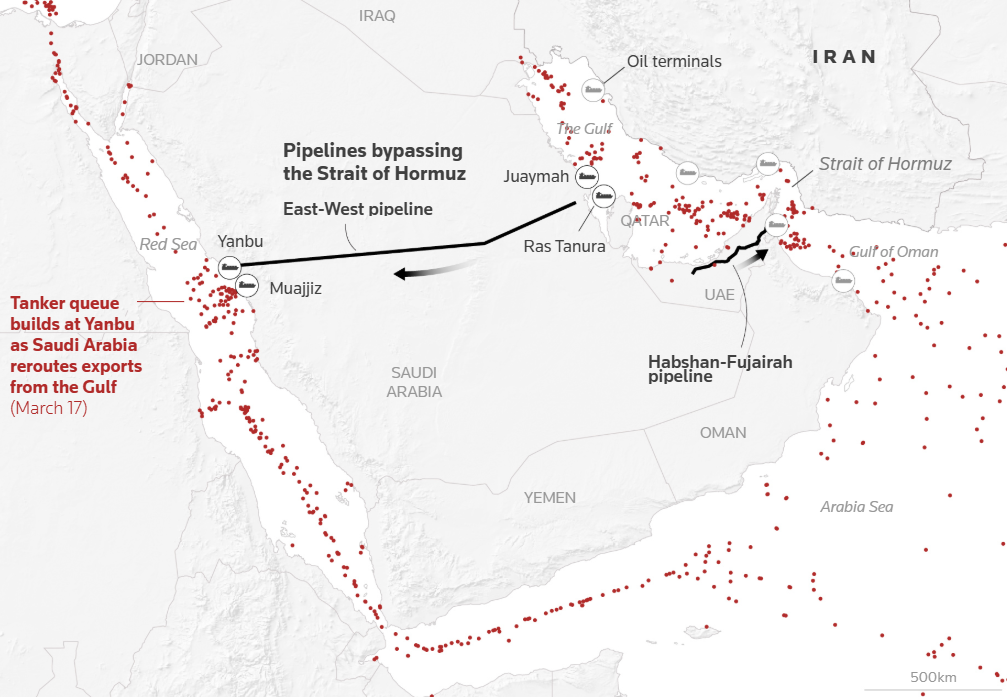
(Source: MarineTraffic, Global Energy Monitor, and European Commission)
In the United States, the national average gasoline price reached $3.97 on Monday, a 36 percent increase in 30 days, leaving the Federal Reserve confronting a stagflation dynamic in which slowing growth and rising inflation simultaneously constrain its capacity to act. Chevron’s chief executive, Mike Wirth, offered the starkest assessment: “There are very real physical manifestations of the closure of the Strait of Hormuz that are working their way around the world through the system that I don’t think are fully priced in.” It is precisely this economic devastation, still working its way through supply chains and balance sheets, that lends the peace summit being assembled in Islamabad an urgency that transcends the diplomatic.
Climate Impact of U.S.-Israel War on Iran
A Carbon Surge in Two Weeks
The first fourteen days of the U.S.-Israel war on Iran released more than five million metric tons of carbon dioxide equivalent, according to an analysis by the Climate and Community Institute. This exceeds Iceland’s annual emissions and rivals the combined yearly output of the 84 lowest-emitting nations on earth. The accounting, still incomplete, points to a conflict that is as ecologically destructive as it is geopolitically consequential.
Destroyed buildings constitute the largest single source of emissions. The Iranian Red Crescent Society reports approximately 20,000 civilian structures damaged or destroyed, encompassing residential buildings, medical centers, and schools. The carbon cost of eventual reconstruction is estimated at 2.4 million tons, which is comparable to the Maldives’ entire annual output. Attacks on oil infrastructure represent the second-largest contributor: between 2.5 million and 5.9 million barrels of oil consumed in strikes on storage depots, refineries, and tankers across the Gulf region have generated roughly 1.9 million tons of carbon dioxide equivalent.
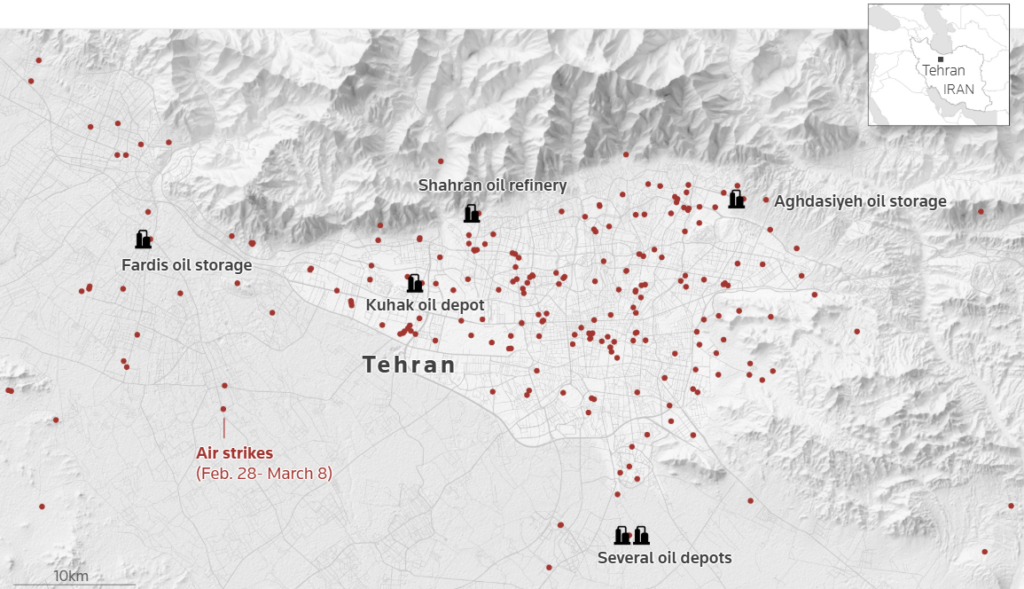
(Source: Institute for the Study of War & AEI Critical Threats Project)
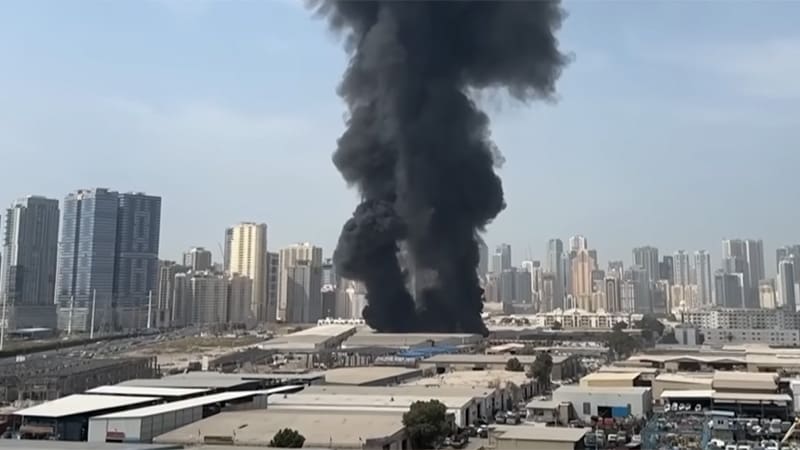
When Israeli munitions struck four major fuel storage depots surrounding Tehran, the resulting fires produced a dense black smoke that subsequently fell as “black rain” over the capital, prompting the World Health Organization to issue health warnings directed specifically at children.
Black Rain Over Tehran
When Israeli munitions struck four major fuel storage depots surrounding Tehran on the night of March 7–8, the resulting fires ignited vast reserves of crude oil and refined fuel. This sent a towering plume of black smoke into the lower atmosphere. The combustion released substantial concentrations of toxic hydrocarbons, sulfur dioxide, and nitrogen oxides, compounds that, upon combining with atmospheric moisture, produced acid precipitation over the capital. The Iranian Red Crescent Society warned that exposure to this category of rainfall carries the risk of chemical burns to the skin and serious pulmonary damage.
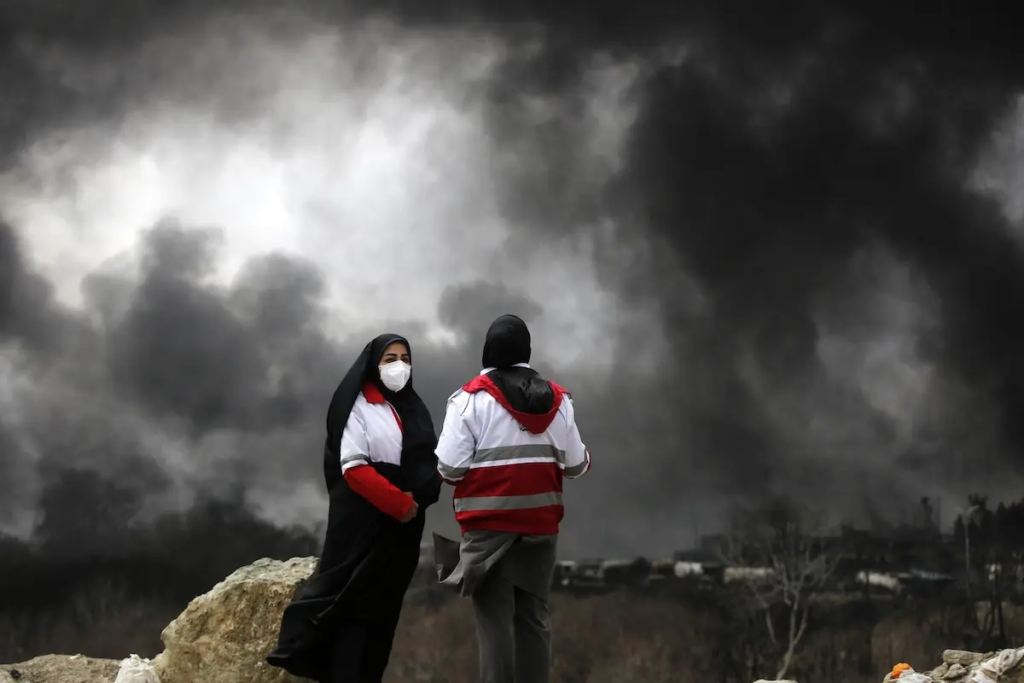
(Credit: Fatemeh Bahrami / Anadolu Via Getty Images)
The inhalation of acidic particulate matter irritates the respiratory tract, aggravates existing conditions such as asthma and bronchitis, and enables fine particles to enter the bloodstream, where they impose measurable cardiovascular stress. Iranian authorities advised residents to remain indoors and issued specific warnings to children, the elderly, pregnant women, and those with pre-existing cardiac or pulmonary conditions against any outdoor exposure.
Iran’s foreign ministry characterized the strikes as representing “a dangerous new phase” of the conflict. It stated that by targeting fuel infrastructure, the attacking forces were “releasing hazardous materials and toxic substances into the air, poisoning civilians, devastating the environment, and endangering lives on a massive scale.”
U.S.-Israel War on Iran: Military Operations and Fuel Consumption
The United States has conducted more than 8,000 combat flights since hostilities commenced. Fighter jets, bombers, drones, reconnaissance aircraft, and refueling tankers have collectively consumed an estimated 150 million to 270 million liters of fuel in the first two weeks alone, generating 529,000 tons of emissions. A single F-35 combat sortie of two hours burns approximately 6,000 liters of kerosene and emits 14 to 17 tons of carbon dioxide, roughly the lifetime emissions of a conventional passenger car. Downed military hardware compounds the ledger further: the United States has lost four aircraft, while Iran has lost 28 aircraft, 21 naval vessels, and approximately 300 missile launchers, with manufacturing replacements projected to generate an additional 172,000 tons of emissions. The munitions expended across more than 6,000 struck targets, alongside roughly 1,000 Iranian missiles, 2,000 drones, and 1,900 defensive interceptors, account for a further 55,000 tons, an environmental ledger whose full weight will bear directly on the terms any peace summit to mediate the U.S.-Israel war on Iran in Islamabad will ultimately be required to address.
A Toxic Legacy
The environmental consequences extend well beyond carbon accounting. Researchers at Pax, a Dutch peace advocacy organization, have documented more than 500 incidents of environmental damage inside Iran and an additional 100 beyond its borders. Strikes on military installations release heavy metals and perfluoroalkyl substances into the surrounding soil and water systems. Fires generate dioxins and furans whose effects on human health are neither immediate nor easily reversed. More than 85 large oil tankers remain trapped in the Persian Gulf, and Greenpeace Germany has warned that a single major spill could inflict damage on coral reefs, mangroves, and seagrass meadows that would persist for decades.
This U.S-Israel war on Iran has also exposed, with uncomfortable clarity, a structural vulnerability that energy policymakers have long identified but governments have been slower to act upon. “The further a country advances its energy transition, the more resilient, and the more sovereign, it becomes,” said Sebastian Kind, Argentina’s former undersecretary of renewable energy. “This war makes that equation impossible to ignore.” The more immediate concern, however, runs in the opposite direction: historically, U.S.-driven energy shocks have been followed by accelerated drilling, expanded LNG infrastructure, and renewed fossil-fuel entrenchment. “This war risks hard-wiring another generation of carbon dependence,” said Patrick Bigger of the Climate and Community Institute – a conclusion that positions the conflict not only as a present catastrophe but as a compounding liability for the decades that follow.
Strategic Impact of U.S.-Israel War on Iran
An Alliance Under Strain
The war has exposed a fundamental asymmetry at the heart of the U.S.-Israel partnership. For decades, successive American administrations maintained a deliberate firewall between Israeli military operations and the broader architecture of U.S. strategy in the Middle East. That firewall no longer exists. Israeli and American aircraft mounted a synchronized campaign against Iran, the first occasion on which the two militaries have operated together in so direct and coordinated a fashion. The integration was not incidental. Following the Abraham Accords, Israel was formally incorporated into U.S. Central Command, enabling joint planning and training at an institutional level. General Michael Kurilla, the former Centcom commander, reportedly visited Israel forty times.
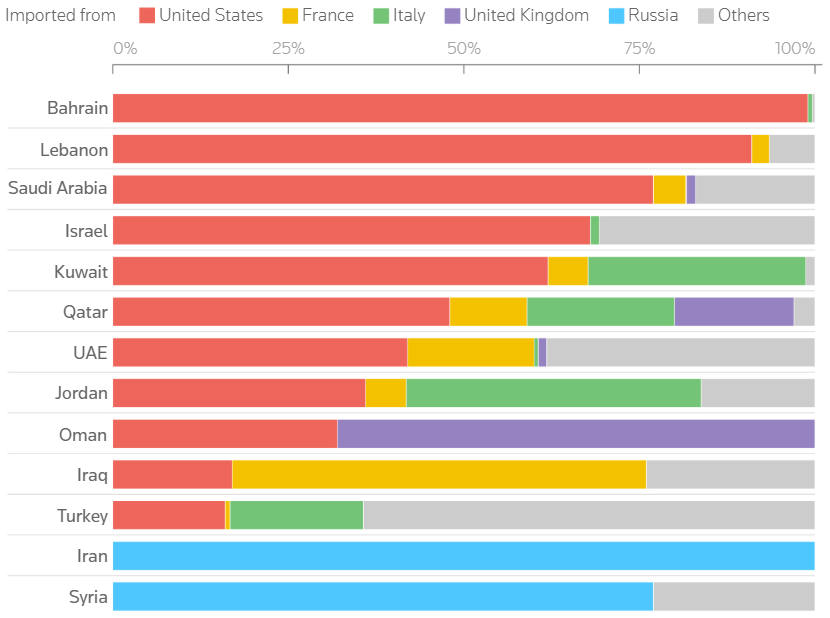
(Source: SIPRI)
The closeness carries costs that are now becoming fully apparent. The United States has aligned itself with Israeli war aims, setting the conditions for regime collapse, without articulating a coherent strategy for achieving them. President Trump’s stated objectives have shifted repeatedly: from preventing a nuclear weapon to destroying missile production infrastructure, to encouraging a popular uprising.
Gulf Partners Bear the Price of U.S.-Israel War on Iran
The Gulf states find themselves absorbing the heaviest burden of a conflict they neither initiated nor designed. Iran has directed more than 1,700 missiles and drones at the United Arab Emirates since hostilities began, more than at any other country, including Israel. Iranian leadership regards Dubai as the institutional foundation of the Western economic order in the region.
The presence of American military installations across the Gulf has become a liability of considerable strategic consequence. Al Udeid Air Base in Qatar hosts approximately 10,000 U.S. troops and serves as the forward headquarters of U.S. Central Command. Prince Sultan Air Base in Saudi Arabia, Ali al-Salem Air Base in Kuwait, and comparable facilities across the region have functioned as essential platforms for American operations, yet Iran has cited precisely these installations to justify its campaign. The Revolutionary Guard has stated it is directing 60 percent of its firepower against what it characterizes as U.S. bases and strategic interests in neighboring Arab countries. This calculus renders the security architecture of every Gulf host nation a direct variable in whatever framework the peace summit in Islamabad will be required to negotiate
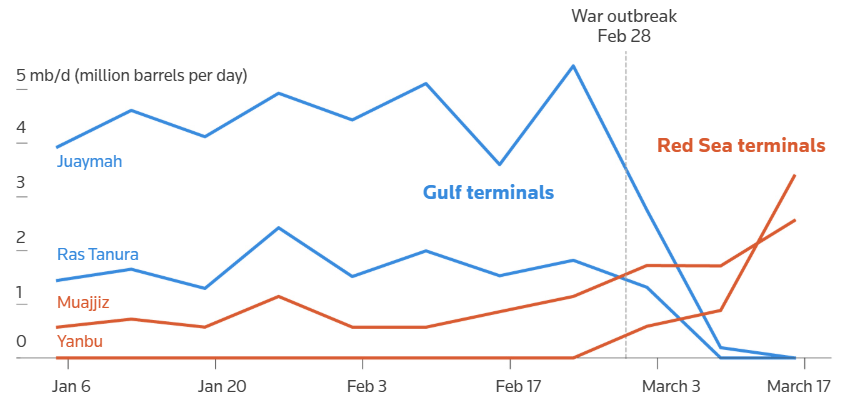
(Source: Kpler)
The UAE has expended tens of billions of dollars on American air defense systems now actively engaged in protecting Emirati territory in this U.S.-Israel war on Iran, yet the psychological damage has proven more resistant to containment than the physical.
Israeli Strategic Preferences rather than American National Interests
The sense that Washington was drawn into the conflict by Israeli strategic preferences rather than American national interests has not dissipated. Saudi Arabia’s former intelligence chief, Prince Turki al-Faisal, gave that sentiment its most direct expression when he told CNN: “This is Netanyahu’s war.” Oman’s foreign minister, writing in The Economist, went further, arguing that “America has lost control of its own foreign policy” and that Washington’s allies bore a responsibility to help extricate the United States from what he termed “this unwanted entanglement.”
(Source: Arab Center, Washington DC)
The longer-term realignment is already visible in the patterns of Gulf diplomacy. Regional states have begun diversifying their security partnerships and deepening institutional ties with Turkey, Pakistan, and European powers in ways that would have seemed improbable a year ago. The decades-old security architecture with Washington is unlikely to dissolve abruptly, but its underlying foundations have been subjected to a stress test of a kind its architects never anticipated. It is precisely this realignment, still in motion, that gives the peace summit convening in Islamabad a constituency far broader than the two principals it was designed to bring together.
A Force Multiplier for Washington
The U.S.-Israel War on Iran has nonetheless demonstrated the operational value of the alliance architecture the United States has assembled over decades. Israel provides offensive capability that no other partner can replicate. The Gulf states provide basing rights, early warning systems, and interception capacity. Secretary of Defense Pete Hegseth characterized fighting alongside Israel as “a true force multiplier and a breath of fresh air.” The lesson has not been lost on Beijing, which observes the conflict with a structural problem in plain view: the United States prosecutes war alongside a network of capable, integrated allies, while China maintains a single formal treaty ally in North Korea. In the event of a conflict over Taiwan, American allies, Japan, South Korea, and the Philippines, would provide forward basing, intelligence sharing, and logistical depth. China would face that contingency without equivalent support.
U.S.-Israel War on Iran: A Strategic Crossroads
The United States now confronts a dilemma of its own construction. The decapitation strike did not produce regime collapse. Iran has neither capitulated nor fractured along anticipated fault lines, and has instead retaliated against Gulf energy infrastructure while demonstrating that its military retains meaningful capacity despite the damage absorbed.
Zionism’s Greater Israel Plan that could trigger a World War
Vision Beyond Borders: Defying International Order
Israeli Prime Minister Benjamin Netanyahu has openly declared his commitment to the “Greater Israel” vision on multiple occasions. In an August 2025 interview with i24NEWS, he described himself as being on a “historic and spiritual mission” rooted in Revisionist Zionism, an ideology that seeks Israeli control not only over Gaza, the West Bank, and East Jerusalem, but over portions of Egypt, Jordan, Syria, Lebanon, Iraq, and Saudi Arabia. The territorial ambition is not new: Theodor Herzl recorded in his diaries that the envisioned state should stretch “from the brook of Egypt to the Euphrates.”
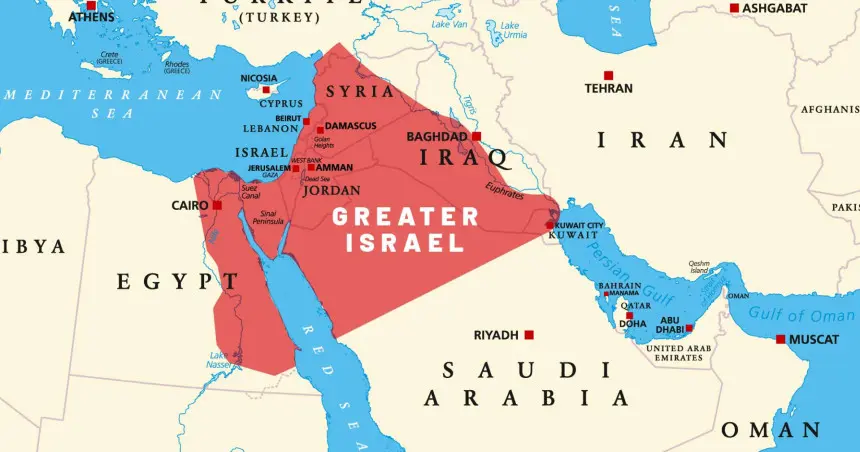
(Credit: Peter Hermes Furian / shutterstock.com)
The regional response has been unambiguous. Jordan’s foreign ministry condemned Netanyahu’s remarks as “a dangerous and provocative escalation” and a direct threat to state sovereignty. Turkish President Recep Tayyip Erdoğan warned in May 2024 that if Israel is not stopped, it will “set its eyes on Anatolia with its delusion of a promised land.”
The Yinon Plan and Regional Fragmentation
The strategic blueprint for this expansion was articulated decades ago. In a 1982 essay, Oded Yinon outlined a vision for the dissolution of Arab states along ethnic and sectarian lines, identifying the fragmentation of Syria and Iraq as Israel’s “primary target on the Eastern front in the long run” and proposing Lebanon’s disintegration as a replicable model. Contemporary Israeli strategists continue to invoke analogous frameworks. Saul Cohen’s geopolitical writings describe the Middle East as a “shatterbelt” in which the number of sovereign states could expand through devolution, a formulation that implicitly justifies the redrawing of borders at existing nations’ expense.
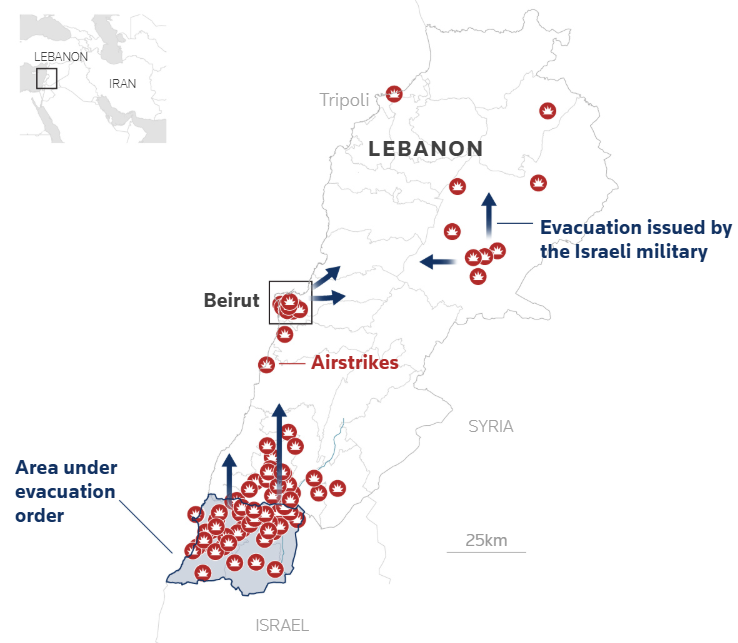
(Source: Israel Defense Forces, Institute for the Study of War & AEI Critical Threats Project)
The conduct of the current war is consistent with this logic. Netanyahu has rejected a two-state solution outright. His government has advanced the E1 project, designed to sever the territorial connection between Ramallah, East Jerusalem, and Bethlehem, while approving thousands of new settlement units in the West Bank and pursuing the systematic depopulation of Gaza. Far-right cabinet ministers Bezalel Smotrich and Itamar Ben-Gvir have called explicitly for the permanent removal of Palestinians from both territories. Smotrich has denied that Palestinians constitute a nation or hold any land rights.
Implications for Mediation and Regional Stability
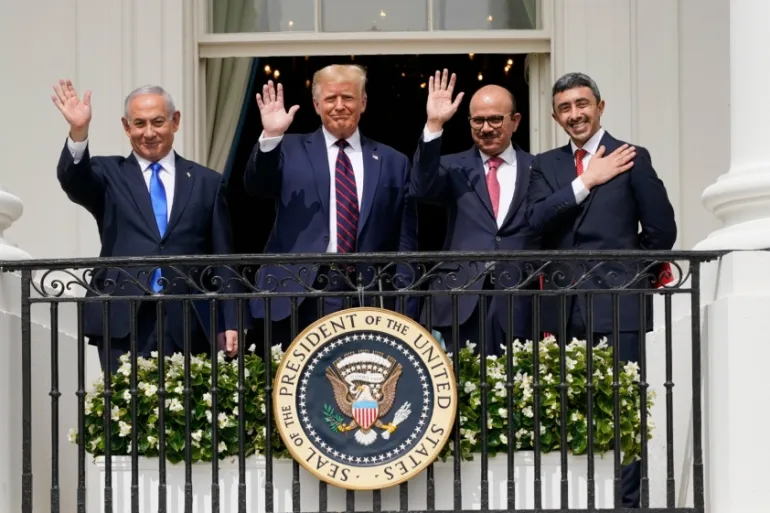
The Greater Israel vision places the mediation efforts currently being pursued by Pakistan, Turkey, and Egypt on structurally uncertain ground. If Israeli war aims extend beyond neutralizing Iran’s military capacity to encompass territorial expansion and the deliberate fragmentation of neighboring states, the diplomatic framework being assembled in Islamabad rests on a foundation its architects have not publicly acknowledged. For Gulf states, the implications are more immediately unsettling: maps of Greater Israel circulated by Israeli soldiers and officials include substantial portions of Saudi Arabia, Jordan, and Iraq.
(Credit: Alex Brandon / AP Photo)
The Abraham Accords were premised on a shared interest in containing Iran; if Israel’s ultimate ambition is territorial absorption rather than regional coexistence, the strategic calculus of every Arab capital is fundamentally altered. The current war may be less about neutralizing a nuclear threat than about advancing a territorial project that, pursued to its conclusion, would guarantee perpetual conflict and risk drawing great powers into a conflagration none of them has formally prepared for.
Global Peace Summit & the Need for an Alliance of Humanity
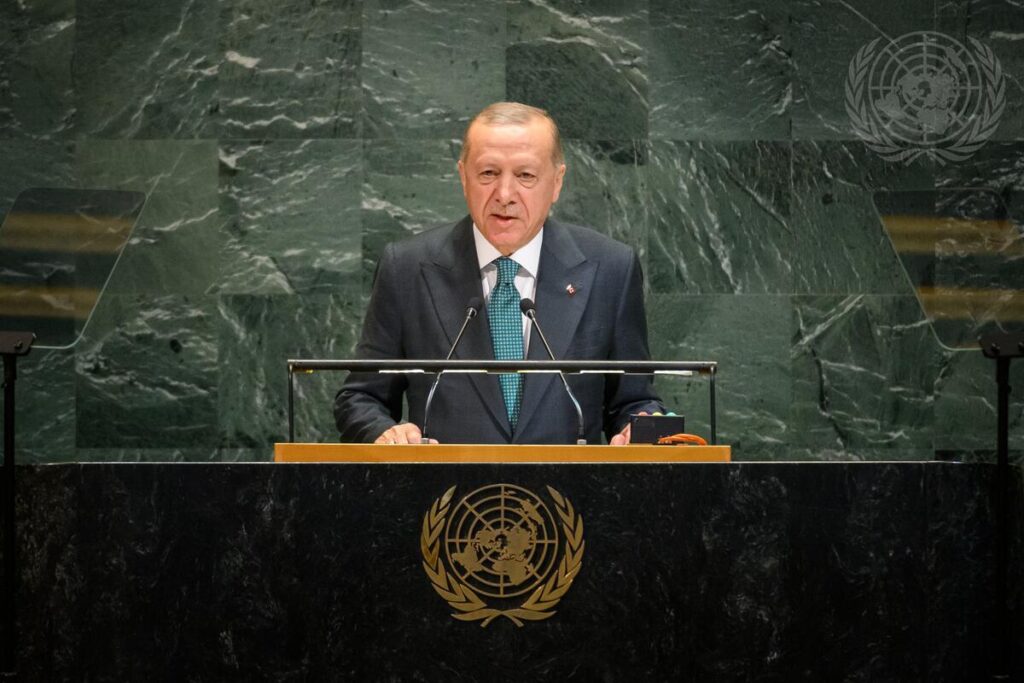
The war in the Middle East is a stress test of the international order itself, of the proposition that diplomacy retains utility in a world where force has repeatedly proven more immediately decisive. Turkish President Recep Tayyip Erdoğan warned at the United Nations in September 2024 that “the values of the UN system and the Western world are dying in Gaza,” that children perish, but so too does the truth, and so too do the principles that were meant to constitute the foundation of a civilized international system.
(Credit: United Nations)
Pakistan’s peace summit is therefore consequential beyond its immediate diplomatic objectives of mediating the U.S.-Israel war on Iran. The alternative is not simply a prolonged war but the progressive erosion of the assumption that sovereign nations can resolve their differences without recourse to perpetual violence.
What the moment demands is what Erdoğan identified at the United Nations: an “alliance of humanity,” not a coalition of the powerful arrayed against the weak, but one of collective conscience arrayed against collective indifference.